

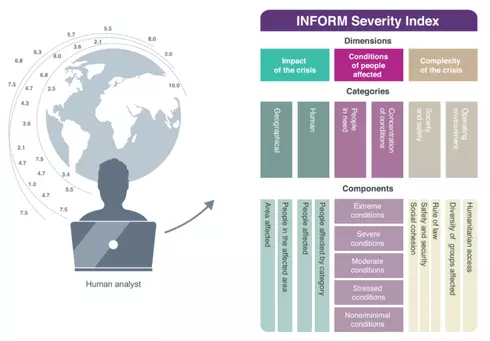
The INFORM Severity Index is a quantitative tool for assessing humanitarian scale and severity of need. The statistically robust model includes data from a wide variety of sources that capture the dynamic impacts and structural characteristics of humanitarian crises. The Index enables severity comparisons of crises globally both at the national and subnational level.
INFORM Severity is one of several quantitative tools within the INFORM product suite. ACAPS implements INFORM Severity and works collaboratively with the Joint Research Centre at the European Commission on the methodology. Together, the Severity Index methodology was upgraded at the start of 2026. The enhancements to the methodology improve the precision of the scores and alignment to INFORM Risk and INFORM Warning. For more information, please see the methodology note.
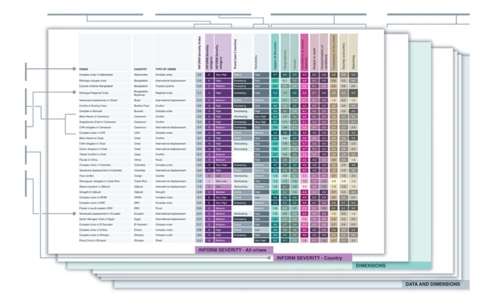
The INFORM Severity Index aggregates information from a range of credible publicly available sources and provides a reliability level estimate for each crisis. It also provides information on the 'distribution of severity' (i.e. the number of people that fall into different categories of severity within the same crisis, which constitutes the second pillar of the model).
Not all people affected by a crisis are equally affected, with different levels of need requiring different responses. This distribution is important in understanding the overall severity of a crisis.
Not all are equally affected by a crisis
How does it work?
The INFORM Severity Index is a composite index bringing together over 30 core indicators organised in three dimensions: impact of the crisis, conditions of affected people, and complexity of the crisis. All indicators are scored on a scale of 0 – 10 updated from the previous 0 – 5 scale to align with INFORM Risk and Warning products.
Indicators, components and categories are combined to produce an overall severity score through a weighted aggregation schema. The overall severity score for the crisis is the most sensitive to the conditions of people affected (66%), followed by impact (33%) and complexity (30%).
The final score of each crisis is assigned to one of five categories ranging from very low to very high.
Adding a crisis
We consider adding a crisis a crisis to the Index if it meets the following inclusion criteria:
The number of people affected is at least 30,000 or is at least 1% of the total population
Or, the number of people in need is at least 10,000 people.
The decision to activate a crisis in the Index also depends on the country’s capacity to respond to the shock, or if the country requires external humanitarian intervention to manage the crisis. This assessment includes a consideration of INFORM Risk scores.
Removing a crisis
If crisis is removed from the Index if conditions have improved to a point where sustained external humanitarian intervention is no longer needed, and/or the core indicators fall below the same thresholds as opening a crisis.
For sudden-onset disasters, a crisis is removed if there is no updates on needs after three months. For protracted crises, there is no strict temporal rule. However, a crisis will be considered for closure if data is more than a year old and there is no supporting qualitative information to evidence an ongoing crisis.
According to DG ECHO, INFORM Severity supports evidence-based policymaking by offering the humanitarian community a common, neutral, and scientifically grounded framework for comparing and prioritising crises. They have used the tool since 2020, integrating it into funding allocation methodologies and internal decision-making processes.
UNOCHA
INFORM Severity has been integrated into the UNOCHA CERF’s Index for Risk and Vulnerability Index (CIRV) since 2020 and is part of the Underfunded Emergencies allocation process. A common, composite severity scale contributes to more transparent, evidence-based funding recommendations to the Emergency Relief Coordinator.The INFORM Severity Index is one of the core databases for HDX Signals, supporting global trend monitoring and used by the CERF to support allocation decisions.
IFRC
Since 2022, INFORM Severity has played a pivotal role in IFRC's Crisis Categorisation process — the mechanism that determines how the organisation mobilises resources and assigns accountability in emergencies. It provides an objective, comparable measure of humanitarian conditions that directly shapes decisions on when and where to act. IFRC uses ACAPS Severity Index API enabling faster, more transparent, and more consistent categorisation decisions — strengthening evidence-based response and local action across its global network.
Related content


CHECK IT OUT!
ALL OUR DATA IS FREELY AVAILABE
INFORM SEVERITY INDEX