

Latest updates on country situation
15 July 2026
By 14 July 2026, the two earthquakes of magnitudes 7.2 and 7.5 that struck northern Venezuela on 24 June had killed 4,700 people, injured 16,700, and rendered nearly 18,000 displaced or homeless, with up to 55,400 still missing. The double earthquake has destroyed or damaged 856 buildings, including health centres and schools, and affected 6.8 million people. Search-and-rescue operations are winding down. The affected people need temporary shelter, health services, and food kits. (OCHA 15/07/2026, PI 08/07/2026, HOPE 08/07/2027)
30 June 2026
On 24 June 2026, two earthquakes of magnitudes 7.2 and 7.5 struck Aragua, Carabobo, Cojedes, Falcon, La Guaira, Lara, Miranda, and Yarucay states and the capital city, Caracas, in northern and central Venezuela, marking one of the most devastating seismic events in Venezuela's history. By 30 June, about 2.4 million people had been exposed to severe shaking from the two earthquakes, including 15,800 people displaced, more than 50,000 reported missing, over 10,600 people injured, and 1,900 killed. These numbers are expected to increase as emergency response efforts continue. The earthquake event collapsed 800 buildings, damaging or destroying 38 hospitals and 433 schools, and damaged main roads, bridges, and tunnels, including the main airport in Caracas, likely constraining the entry of humanitarian organisations and emergency responders into the country and the areas hit. Immediate needs include shelter, WASH, healthcare, ready-to-eat meals, and protection support. (PI 29/06/2026, IFRC accessed 30/06/2026, OCHA 01/07/2026)
06 January 2026
On 3 January 2026, the US Armed Forces carried out air strikes on military targets in and around Caracas and apprehended Nicolás Maduro and his wife. The operation killed over 50, including at least one civilian, although reports vary widely given conflicting accounts from Cuban, US, and Venezuelan sources. A nationwide state of emergency was declared, with security forces deployed in the capital, and Vice President Delcy Rodríguez assumed executive authority. The operation compounds a severe humanitarian crisis, with 7.9 million Venezuelans needing humanitarian assistance. Pre‑existing needs include food insecurity, collapsing health services, and widespread poverty, with another 7.9 million Venezuelans displaced abroad. While information on needs resulting from the attacks remains limited, initial reports point to reduced access to food, water, electricity, healthcare, and communications and heightened risks of protection incidents, especially for children, as armed parties tighten control and communities consider internal or cross‑border displacement. (NYT 03/01/2025, CFR accessed 07/01/2025)
08 July 2025
Since June 2025, a powerful tropical wave has been causing heavy rains, flash floods, and landslides across Venezuela, particularly in the states of Apure, Barinas, Mérida, and Zulia, in the western part of the country. The Government reported that 25,000 people were affected at the end of June. Floods and subsequent landslides damaged nearly 400 homes, as well as roads, bridges, and public services, including the power grid. As a result, communities risk isolation. Damages to the water supply infrastructure and contamination of natural sources have reduced access to drinking water, increasing the risk of waterborne diseases. Some of the states affected already had limited access to healthcare services in rural and remote locations. The people affected require access to WASH, healthcare, and shelter. The Government is responding to the emergency, but Venezuela’s economic and political crisis may hinder its ability to support people in need. (IMC 03/07/2025, El Pais 27/06/2025, IFRC 27/06/2025)
27 February 2024
Food access continues to be a struggle for people in Venezuela, especially households living below the poverty line. The political and socioeconomic crisis, marked by increasing inflation and foreign exchange rates, contributes to increasing food prices. The cost of a basic food basket recorded a 347% increase between October 2022 and October 2023, reducing people’s purchasing power and leading to the use of potentially harmful coping strategies. These strategies include child labour and forced engagement in sexual work for money, goods, or services, increasing protection risks. Based on a recent survey of 11,000 households across 20 states, over 94% of the population do not have sufficient income to purchase goods and services, and above 30% are forced to engage in low-income informal work to access essential services, including food. (OCHA 27/02/2024, HumVenezuela 30/11/2023, Caracas Chronicles 30/09/2021)
current crises
in
Venezuela
These crises have been identified through the INFORM Severity Index, a tool for measuring and comparing the severity of humanitarian crises globally.
VEN003 - Multiple Crises
Last updated 30/09/2026
Drivers
Earthquake
Political/economic crisis
Conflict/ Violence
Crisis level
Country
Severity level
8.5 Very High
Access constraints
7.0
VEN002 - 2026 Earthquake
Last updated 30/09/2026
Drivers
Earthquake
Crisis level
Country
Severity level
6.8 High
Access constraints
5.0
VEN001 - Complex crisis
Last updated 30/09/2026
Drivers
Political/economic crisis
Conflict/ Violence
Crisis level
Country
Severity level
8.2 Very High
Access constraints
7.0
Analysis products
on
Venezuela
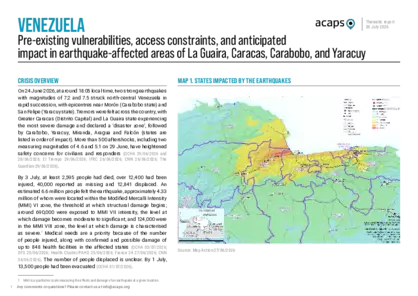
03 July 2026
Venezuela: Pre-existing vulnerabilities, access constraints, and anticipated impact in earthquake-affected areas of La Guaira, Caracas, Carabobo, and Yaracuy
DOCUMENT / PDF / 1 MB
This report brings together current knowledge of the earthquakes’ impacts, pre-crisis conditions in affected areas, and anticipated future impacts. It highlights pre-existing vulnerabilities to support a more informed, targeted humanitarian response and identifies different types of access constraints that may affect the response, including the characteristics of the evolving information ecosystem, following the ACAPS access methodology.
23 August 2024
Venezuela: Anticipation of continuing civil unrest
DOCUMENT / PDF / 659 KB
On 28 July 2024, Venezuela held presidential elections that sparked massive protests and a violent response from the Government, as large parts of the population believed that electoral fraud had taken place.
20 July 2023
Venezuela Anticipation of flooding
DOCUMENT / PDF / 323 KB
Since 26 May, there have been heavy rains across Venezuela, especially in the states of Zulia, Táchira, Mérida, Trujillo, Amazonas, Bolívar, Delta Amacuro and Esequibo. The first tropical wave (an elongated area of relatively low air pressure, which moves from east to west across the tropics) of the rainy season (typically between May and November) occurred in June and resulted in flooding.
03 November 2022
Mexico: Venezuelan people stranded in Mexico
DOCUMENT / PDF / 395 KB
On 12 October, the US Department of Homeland Security announced joint actions with Mexico to create a more orderly and safe immigration system for Venezuelans. This aims to reduce the number of people arriving at the southwestern US border. At the same time, the number of stranded people unlikely to reach their destination is increasing, and the response capacity is overwhelmed.
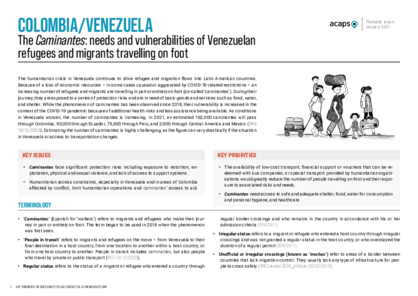
21 January 2021
Colombia and Venezuela: Needs and vulnerabilities of the Caminantes
DOCUMENT / PDF / 3 MB
This report is based on a secondary data review, supplemented by interviews with members of civil society, INGOs, and UN agencies. Although the issue of caminantes is understood to be a regional phenomenon that affects multiple countries, because of the availability of information the focus of this report is on Colombia and Venezuela.