

Now in its fifth year, Russia’s full-scale invasion continues to deepen a protracted humanitarian crisis. Active ground fighting stays concentrated along the front lines in the east, north, and south, while air, missile, and drone strikes threaten civilians and critical infrastructure across the whole country. A full end to hostilities in 2026 remains unlikely, and the war is still the main driver of humanitarian need.
In February 2026, ACAPS brought together 46 context and humanitarian experts in two workshops in Kyiv to explore how the situation could develop over the year.
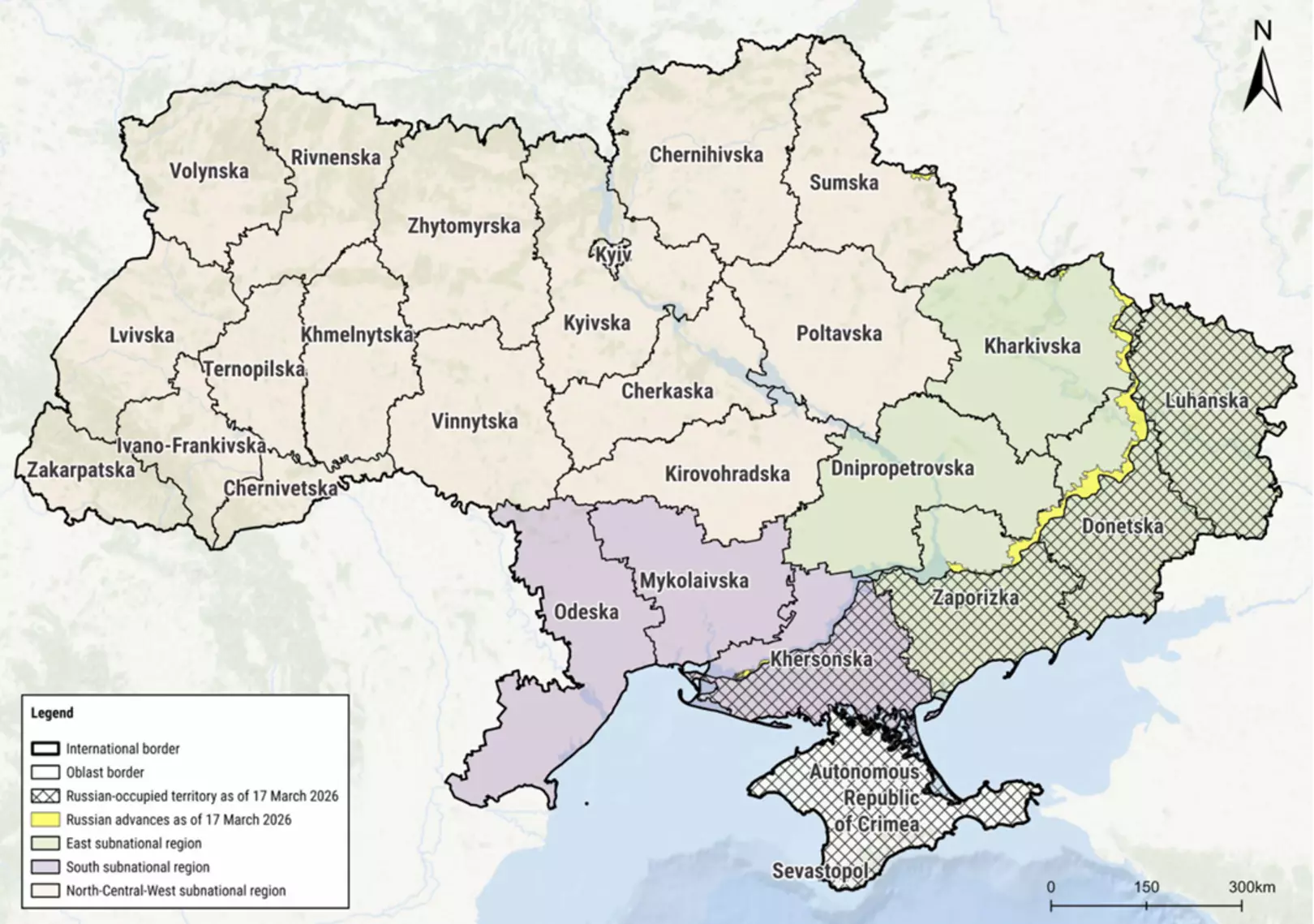
CURRENT NATIONWIDE SITUATION AS OF 17 MARCH 2026
3.7M
Internally displaced persons
(19 January 2026)
10.8M
People in need
(13 January 2026)
3-5M
Persons under occupation
(20 February 2026)
5.9M
refugees in Ukraine
(30 March 2026))
SCENARIOS
The scenarios describe three distinct yet plausible futures for Ukraine through the end of 2026, presented in order of probability. They are shaped by different combinations of key drivers: shifts in international support dynamics, the trajectory of peace negotiations, military capacity on both sides, and internal dynamics in Ukraine.
Continued war without resolution
Continued war without resolution
The status quo continues. Hostilities persist while diplomatic engagement carries on without producing results, and peace talks stay deadlocked over territory and security guarantees. The result is a war of attrition with only limited, incremental gains in the east.
Communities near the front lines face slow-burning pressure rather than sudden shocks, with household coping capacity eroding under prolonged conflict and continued displacement.Energy, transport, and logistics infrastructure stays at significant risk nationwide, with service disruptions worst in frontline and border oblasts and major cities, especially during the cold season.
Displacement is localised and cyclical, with smaller, harder-to-track flows rather than large-scale movement.
The defining constraint on the response is the growing mismatch between reduced funding and chronic, compounding needs.
Probability: High
Impact: Moderate
Reduction of hostilities
Reduction of hostilities
A fragile de-escalation rather than a durable peace. Ukraine and Russia reach a partial or localised reduction in hostilities, such as a localised ceasefire, frozen front lines, or a drawdown in aerial attacks, as a precursor to a fuller settlement in 2027 or later. Violations are frequent and the situation could easily slip back toward Scenario 1 or escalate towards Scenario 3.
Reduced hostilities do not translate into reduced need in the short term. Needs may stay high or even rise as damaged infrastructure, disrupted livelihoods, and displacement persist.
Perceptions of resolution prompt donors to shift toward recovery and development funding before recovery systems are in place, leaving a gap for those no longer prioritised for emergency aid but not yet reached by recovery programming.
Limited and cyclical returns occur, driven more by economic necessity than by genuine safety, testing housing and employment markets in western cities.
Social tensions grow between those who stayed, those displaced internally, and those who left the country, as expectations of what peace should deliver diverge.
Probability: Medium
Impact: Low
Escalating war
Escalating war
A significant shift in conflict dynamics. Expanded Russian force generation, the cumulative degradation of Ukrainian defences, and interruptions in external military support combine to enable a strategic breakthrough in Donetska oblast, opening the way to rapid advances, the encirclement of urban centres, and disruption of critical logistics corridors.
Aerial strikes on energy, transport, and logistics intensify, shifting toward smaller, distributed nodes that are harder to repair, cascading into service disruptions for both military operations and civilian life.
Evacuations surge, especially in the east. Those with resources move quickly and far, potentially to neighboring countries, while older people, people with disabilities, and those with depleted savings risk being isolated in place.
The humanitarian system is fundamentally overstretched, with the tightest constraints emerging first in evacuation capacity and logistics, compounded by staffing shortfalls linked to military mobilisation.
International funding does not scale with needs as defence financing absorbs a growing share of resources, widening assistance gaps at the moment needs are greatest.
Probability: Low
Impact: Major
Across all three scenarios, the war remains the primary driver of humanitarian needs, and the gap between needs and response capacity is likely to widen.
WEBINAR
want more highlights?
Watch the full presentation of the three scenarios for Ukraine in 2026.