

Following the US–Iran Memorandum of Understanding (MoU), ACAPS worked with around two dozen regional experts to identify the four most likely scenarios for the region through to the end of 2026.
‘No War, No Peace’ was the status quo and analytical baseline when the scenarios were developed. After the signing of the MoU, the ‘Tactical Deal’ has become the new baseline.
TACTICAL DEAL
TACTICAL DEAL
Likelihood: Current baseline (possible)
In this scenario, the US and Iran reach a narrow agreement addressing some of the most acute issues arising from the regional war, but not their causes. The current MoU is a 14-point agreement to ensure freedom of navigation through Hormuz tied to a comprehensive ceasefire, which aims to ease some global economic pressures and tensions in the Gulf. The narrow deal is meant to provide space for comprehensive talks over the core issues of Iran’s nuclear programme and sanctions relief. However, this MoU is likely to be hard to sustain if those talks do not proceed. The 60-day window for negotiations is ambitious considering that the previous US-Iran agreement (the JCPOA) required 20 months of intensive talks. Fulfilling the commitments of the MoU, especially the large financial benefits to Iran, will also face strong political headwinds in Washington.
The scenario’s greatest vulnerabilities are (1) Israeli opposition to a US–Iran settlement expressed via direct lobbying of the Trump administration and a persistent military campaign in Lebanon, and (2) a growing sense in Iran that talks are unacceptably dragging, leading to prolonged economic costs on the regime, and amplified calls from hardliners to use the conflict’s levers to accelerate US action.
No war, no peace
No war, no peace
Likelihood: Medium-high likelihood
In this ‘No War, No Peace’ scenario, the US and Iran continue to extend the MoU’s ceasefire (in reality, more like a truce) without making tangible progress toward a settlement that permanently ends hostilities. As its name suggests, this scenario is likely to be quite ambiguous: sporadic episodes of conflict place stress on the ceasefire, but do not overturn it; progress on the opening of Hormuz moves forward, but confidence in safe passage is not fully restored.
This scenario could well prove pervasive, leaving the region in a tense limbo, and is more likely to transition toward re-escalation than a political settlement because of diverging US and Iranian interests and the constant stress of triggering events, including Israeli attacks on Lebanon and tit-for-tat attacks by the US and Iran. Both sides have an incentive to maintain the appearance of progress while avoiding the substance of a deal, producing a prolonged limbo stable enough to persist but fragile enough to collapse rapidly.
Re-escalation
Re-escalation
Likelihood: Medium likelihood
In this ‘re-escalation’ scenario, the direct US/Israel-Iran conflict resumes, likely accompanied by intensifying fighting in Lebanon and, potentially, Houthi attacks on Red Sea shipping from Yemen. Gulf states return to a defensive crouch and pursue diplomacy, but the UAE at least considers direct action if Iran strikes sensitive infrastructure. Re-escalation, however, does not necessarily entail a return to the maximalist conflict seen in March. The scope and intensity will likely differ, but the key point is that the ceasefire is dissolved and the conflict re-enters an open-ended phase.
While the next round of conflict may be designed by US-Israel as a final salvo, fighting could prove difficult to contain if it reaches a certain threshold. For example, a US ground invasion of Iranian islands or fighting between US forces and Iraqi groups could lead to significant loss of life, leading Washington and Tehran to double down in order to prevent a loss of face at home.
The most plausible trigger leading into this scenario comes from Israel’s actions. A resumption of largescale fighting in Lebanon is the most likely initial trigger, pulling the US and Iran back into direct confrontation as Israeli and Hezbollah exchanges cross a threshold that Tehran feels it cannot ignore. Equally, a miscalculated attack in the Strait of Hormuz, such as an Iranian strike that kills US military personnel, could prompt the Trump administration to resume full-scale war. A second round of fighting would be harder to contain than the first. The IRGC has greater incentive to escalate directly, and Gulf states already demonstrated vulnerability to Iranian strikes in the first round.
US withdrawal
US withdrawal
Likelihood: Low likelihood / wildcard scenario
In this scenario, the US simply declares victory and withdraws a substantial portion of the forces it currently has stationed in the region, potentially reducing its regional footprint to below pre-February 2026 levels. Iran would likely claim a strategic victory and attempt to consolidate its control over the Strait of Hormuz, while Israel would likely conduct attacks on Iran and its Axis of Resistance allies. One possibility under this scenario is some kind of renewed UAE–Israeli–Iranian conflict, while another is a push by some Gulf states toward a new regional security architecture.
Under this scenario, the US would effectively declare victory and significantly reduce its military engagement in the region, leaving Gulf states increasingly responsible for managing regional security dynamics independently. A US withdrawal would significantly reshape the regional balance of power and accelerate the emergence of competing regional security architectures. Iran could exploit the reduction in US deterrence to expand political and economic influence through asymmetric tools, maritime leverage, and regional proxy networks. Israel may increasingly pursue unilateral military actions against Iran or Hezbollah in an attempt to prevent the emergence of a post-US regional order perceived as unfavourable to Israeli interests.
The main trigger for this scenario could be the Trump administration’s desire to declare victory before midterm elections. Which sub-scenario emerges – a regional conflict or a push towards regionalised security architecture – will depend on the calculations of Israel and the UAE, on one hand, and other regional players on the other, as well as the approach taken by the new political elite in Iran.
ANALYSIS SPOTLIGHT
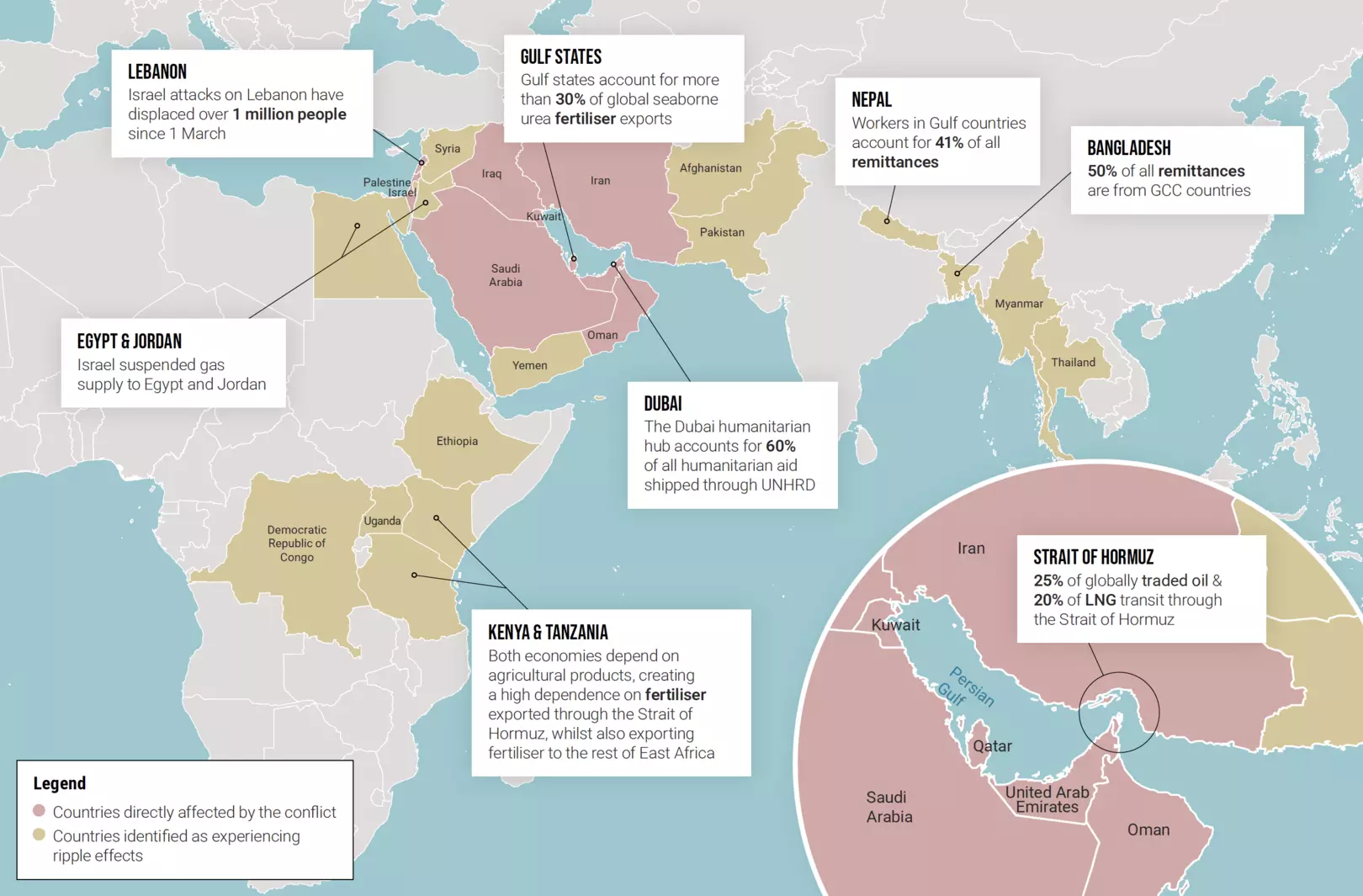
The conflict has fundamentally disrupted global trade and energy systems. Approximately 25% of globally traded oil and around one-fifth of global LNG normally transit through the Strait of Hormuz, which has been largely blocked since hostilities began. Disruptions to energy, fertiliser, and remittance systems continue to negatively impact people across Africa, South Asia, and beyond.
~3,500
people killed in Iran
since 28 February
~3,200
people killed in Lebanon
since 2 March
Within ten days of the initial attacks on Tehran, the conflict was already disrupting global trade and energy systems. Approximately 25% of globally traded oil and around one-fifth of global LNG normally transit through the Strait of Hormuz. Disruptions there send shocks through food, fertiliser, and remittance systems that reach communities across Africa, South Asia, and beyond.
PREVIOUS ANALYSIS
RIPPLE EFFECTS
The conflict is generating ripple effects across four interconnected themes.
Released 20 March 2026
Even with a swift resolution to the conflict, the economic and humanitarian impacts will likely persist into 2027
Analysis products
on
Middle - East Conflict
22 June 2026
US-Israel-Iran: four scenarios for the regional conflict, June-December 2026 outlook
DOCUMENT / PDF / 577 KB
The conflict’s trajectory carries significant humanitarian implications in numerous contexts across the Middle East and North Africa (MENA) region and beyond. To help humanitarian planners manage the highly uncertain operating environment, this report describes the four most likely scenarios for the coming six months.

10 June 2026
Afghanistan: Anticipated impacts of the Middle East and Pakistan–Afghanistan conflicts on trade and associated humanitarian needs
DOCUMENT / PDF / 1 MB
This report examines the interlinked impacts of the Afghanistan–Pakistan and Middle East conflicts on Afghanistan’s trade, along with associated humanitarian impacts. The report identifies both current and anticipated impacts over the coming six months to inform response planning and design, and explores anticipated impacts up to and beyond 12 months where relevant and possible.
09 June 2026
Lebanon: Escalation of conflict and forced displacement in southern areas
DOCUMENT / PDF / 2 MB
Since 2 March 2026, intensified conflict between Israel and Hezbollah has triggered a major humanitarian crisis in Lebanon. Over one million people have been displaced, with 3,412 killed and more than 10,000 injured (IOM 02/06/2026; OCHA 30/05/2026). Israeli operations expanded significantly in late May, and by 1 June, approximately 2,000 km² – nearly one‑fifth of Lebanon – was under Israeli control, marking the largest incurion in 26 years

28 April 2026
Bangladesh: Ripple effects of the Middle East Crisis on Cox's bazar
DOCUMENT / PDF / 3 MB
LPG has been life-changing in the Rohingya refugee camps (Bangladesh), but the US - Israel military offensive against Iran is putting supply at risk.

22 April 2026
Ukraine: impacts of the 2026 Middle East conflict
DOCUMENT / PDF / 341 KB
On 28 February, the United States and Israel launched a joint military offensive against Iran, prompting a regional escalation in the Middle East that has significantly disrupted global commodities markets and supply chains.