
Latest updates on country situation
06 October 2026
Between 1–23 September 2026, flooding across 15 states affected nearly 228,000 people and displaced over 132,000. By 18 September, over 53,000 people were in need across 11 states. Ondo state had an estimated 72% of its affected people displaced, the highest share among assessed states. Displaced families are sheltering primarily with host families or in makeshift structures, while over 500 households remain completely without shelter. Living conditions are critical as 81% of assessed households reported damage to their main shelter, nearly 59% reported that food was unavailable, and about 54% reported that their available water was unsafe or not clean. In affected states such as Benue, communal tensions, criminality, and banditry act as compounding factors and may restrict humanitarian access. Immediate priorities include multipurpose cash assistance, emergency shelter, clean water, hygiene kits, and protection support. Heavy rains along the Niger and Benue basins are forecast through late 2026, further worsening displacement and delaying long-term recovery. (IFRC 05/10/2026, GDACS accessed 06/10/2026, Channels 25/09/2026)
30 September 2026
Between 26–27 September 2026, armed bandits abducted at least 87 people, mostly women, in Niger and Zamfara states. They include 47 farmers in Rimi, Mariga local government area, Niger state, and around 40 women in Yargada, Gusau area, Zamfara state. The kidnappings highlight Nigeria's worsening insecurity: ransom payments reached NGN 7.8 billion (nearly USD 6 million) between July 2025 and June 2026, triple the NGN 2.6 billion paid in the same period the previous year. The abductions raise protection concerns and disrupt harvest activities. (AJ 29/09/2026, AJ 24/08/2026, France24 28/09/2026)
23 September 2026
Armed violence in Kebbi State continues to escalate from localised farmer-herder tensions and cattle rustling into organised banditry, kidnapping, and communal clashes, intensified since 2024 by the emergence of armed groups like Lakurawa. Since 17 August, attacks across seven Local Government Areas (Bagudo, Danko Wasagu, Jega, Koko Besse, Sakaba, Shanga, and Yauri), affected over 16,600 people, killing at least 33, injuring 108, and displacing 7,700 people by 31 August. Violence also caused the destruction of an unknown number of homes, water infrastructure, and livelihoods. The displaced families are sheltering in host communities, informal settlements, or overcrowded public buildings like schools and health centres across the seven conflict-affected Local Government Areas, completely overwhelming local capacities. These overcrowded sites lack basic privacy and gender-sensitive WASH facilities. Children face severe psychological distress, educational disruption, and heightened risks of separation, exploitation, and abuse. The most critical needs remain tarpaulins and sleeping mats, food assistance via cash transfers, safe water and treatment, first aid and psychosocial support, and protection services. (IFRC 18/09/2026, IFRC 04/09/2026, Leadership NG 04/09/2026)
26 August 2026
On 13 August, severe flooding in Lafia city, Nasarawa State, displaced more than 300 people into host communities, destroyed homes, damaged businesses, and disrupted livelihoods. Immediate needs include shelter, food, NFIs, and psychosocial support. Livelihood losses and increased pressure on host communities may heighten competition over land, water, grazing areas, and income opportunities, potentially aggravating existing farmer-herder tensions. This is particularly relevant given farmer-herder clashes in Udege since April 2026 have killed at least 32 people and displaced over 200 by July. Flooding may also increase public health risks by contaminating water sources and overwhelming sanitation infrastructure. Nasarawa is among the states affected by Nigeria’s cholera outbreak, which had recorded more than 57,000 suspected cases and 357 deaths across 35 states by mid-August. Displacement into host communities could further strain WASH services and increase the risk of cholera transmission. (IFRC accessed 25/08/2026, UNICEF 14/08/2026, Daily Post 22/07/2026)
29 July 2026
Between 5–12 July 2026, the Borno cholera outbreak worsened sharply, with suspected cases rising from over 28,000 to more than 35,500 and deaths increasing from 143 to 198. The disease has spread further within Borno and into neighbouring Plateau state, straining health facilities. Overcrowding, poor sanitation, unsafe water, and limited healthcare access continue to drive transmission and heighten urgent health and WASH needs. (MSF 22/07/2026, IMC 06/07/2026, VON 28/07/2026)
08 July 2026
By 5 July 2026, the cholera outbreak, first reported in early May in Borno state, had surpassed 28,000 suspected cases and 143 deaths across 20 local government areas (LGAs). Suspected cases increased by 74% between 3 June and 5 July, with Maiduguri Metropolitan Council the worst-affected LGA reporting 11,166 cases. Poor sanitation conditions continue to drive transmission, increasing urgent medical supplies and WASH needs. (IMC 06/07/2026, AAH 25/06/2026, IMC 04/06/2026)
09 June 2026
Armed groups in Nigeria are deliberately targeting civilian gatherings, such as peace meetings, resulting in killings, abductions, education disruption, and heightened risks of child recruitment and early marriage. On 7 June, a non-state armed group in Zamfara state abducted 39 villagers during a reconciliation meeting with the group's leader, luring them under the guise of dialogue – a tactic increasingly used to target civilians. In February, a non-state armed group attacked Woro village, Kwara state, killing at least 170 residents after the community rejected its attempts to impose hardline religious rule; the attackers had been preaching in the village and sending warning letters to residents for months. The full humanitarian impact of individual incidents often remains unclear, but the pattern warrants close monitoring given its potential to erode community trust and reduce access to essential services. (Daily Trust 09/06/2026, AJ 04/02/2026, Truth Nigeria 18/05/2026)
current crises
in
Nigeria
These crises have been identified through the INFORM Severity Index, a tool for measuring and comparing the severity of humanitarian crises globally.
NGA009 - Multiple Crises
Last updated 29/09/2026
Drivers
Conflict/ Violence
International Displacement
Crisis level
Country
Severity level
8.5 Very High
Access constraints
9.0
NGA010 - Conflict in North Central
Last updated 29/09/2026
Drivers
Conflict/ Violence
Crisis level
Country
Severity level
7.4 High
Access constraints
5.0
NGA008 - Displacement from Cameroon
Last updated 29/09/2026
Drivers
International Displacement
Crisis level
Country
Severity level
4.6 Medium
Access constraints
6.0
NGA007 - Conflict in the North West
Last updated 29/09/2026
Drivers
Conflict/ Violence
Crisis level
Country
Severity level
7.9 High
Access constraints
5.0
NGA004 - Conflict in the BAY states
Last updated 29/09/2026
Drivers
Conflict/ Violence
Crisis level
Country
Severity level
8.6 Very High
Access constraints
9.0
Analysis products
on
Nigeria
18 November 2025
Nigeria: conflict dynamics and humanitarian implications in North East, North West, and North Central
DOCUMENT / PDF / 1 MB
This report provides an analytical overview of the escalating, complex, and interlinked violence occurring across Nigeria’s North East, North West, and North Central geopolitical zones.
24 September 2024
Nigeria: humanitarian impact of floods in Borno state
DOCUMENT / PDF / 743 KB
On 9 September 2024, heavy rain and structural damage caused the Alau Dam in Konduga local government area (LGA), Borno state, to collapse. The dam collapse caused flash flooding in neighbouring Maiduguri and Jere LGAs.

28 May 2024
Global increase of cholera: aggravated by vaccine shortage and El Niño
DOCUMENT / PDF / 341 KB
This report highlights the key contributing factors and aggravating conditions that can increase the global prevalence of cholera, focusing particularly on the impact of the global OCV shortage that is heightening humanitarian needs among affected populations and those vulnerable to spread.
Attached resources
03 January 2024
Nigeria: conflict in the northeast and northwest
DOCUMENT / PDF / 201 KB
Violent incidents reported include attacks, kidnapping, and extortion by non-state armed groups (NSAGs), such as Boko Haram and the Islamic State – West Africa Province (ISWAP), as well as militias known locally as bandits.
21 October 2022
Nigeria: country-wide flooding
DOCUMENT / PDF / 1 MB
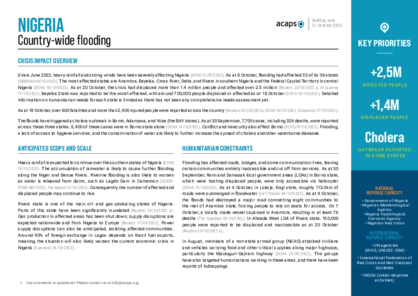
Since June 2022, heavy rainfall and strong winds have been severely affecting Nigeria. As at 6 October, flooding had affected 33 of its 36 states. As at 20 October, the crisis had displaced more than 1.4 million people and affected over 2.5 million. The floods have triggered a cholera outbreak in Borno, Adamawa, and Yobe.