

Latest updates on country situation
02 September 2026
Iran’s economic crisis is deepening, with rising inflation, currency depreciation, and import disruptions increasingly affecting access to food and medicines. Inflation reached 84% in August 2026, up from 52% in December 2025. The Iranian rial has fallen to around 2 million per US dollar, increasing import costs. Food prices, including for bread and wheat, are rising weekly, with some staple costs up by 300%. This is eroding purchasing power, leaving lower-income households increasingly unable to afford food and forcing them to reduce consumption. Medicine access is also increasingly affected. Higher shipping costs, delayed imports of medicines and raw materials, and damage to medical facilities and pharmaceutical factories contribute to shortages and price increases of between 100–1,000% in 2026, including for insulin. Patients are increasingly buying only part of their prescriptions or prioritising essential medicines, increasing risks of treatment interruptions and deteriorating health, particularly for people with chronic conditions. (OCHA 31/08/2026, AJ 29/08/2026, Sky News 31/08/2026)
15 July 2026
US attacks on Iran’s energy infrastructure have damaged the national grid, disrupting the electricity supply and increasing needs during peak summer temperatures. On 12 July 2026, the national electricity company, Tavanir, reported that recent strikes had disabled approximately 4,200MW of generation capacity and damaged more than 2,000 electricity transmission and distribution points, reducing the grid's resilience and recovery capacity. Power outages exceeding three hours daily across Khuzestan, Mashhad, Shiraz, and Tehran provinces are disrupting cooling, water pumping, refrigeration, telecommunications, and healthcare. Prolonged outages during extreme heat increase the risk of heat-related illness, interrupt electrically powered medical equipment, limit access to refrigerated medicine, and reduce access to essential health services, particularly for older people and people with chronic illnesses. The strikes follow the resumption of US attacks on 7 July, which Iranian authorities report killed at least 17 people and injured 115 during the initial strikes from 8–9 July. (Sky News 11/07/2026, INU 13/07/2026, Al Mada 12/07/2026)
13 May 2026
About 3.2 million displaced people and over 1.65 million refugees are likely to face reduced food access, as worsening food insecurity from accelerating inflation and rising food prices disproportionately affect them. This is further eroding household purchasing power and access to essential goods. The Statistical Center of Iran reported an inflation rate of 73.5% in the first month of the Persian calendar, Farvardin (21 March to 20 April), compared to the same period in 2025. The price of a basic food basket increased by 62% between November 2025 and May 2026, costing households 85% of their minimum wage incomes. Price hikes also affected staple items, including Iranian rice (173%) and chicken (191%), in Farvardin 2026 compared to Farvardin 2025. This is likely to heighten existing needs, including increased demand for food assistance, livelihood support, and protection services, among affected displaced and refugee populations. (WFP 10/05/2025, UNHCR 12/05/2026, AJ 10/05/2026)
22 April 2026
From January–March 2026, over 152,100 Afghans returned from Iran to Afghanistan. Those who remain in Iran need access to healthcare, cash for basic needs, and safe shelter, as many Afghans face chronic illness, housing damage, and inadequate resources to relocate from high-risk areas amid conflict-related bombings and air strikes. (IOM 17/04/2026, UNHCR 20/04/2026, UNHCR 02/04/2026)
07 April 2026
Since the escalation of conflict on 28 February 2026, large-scale population movements have been observed in Iran. Based on government estimates, 600,000 to one million households (around 3.2 million individuals) have temporarily fled, mainly from Tehran and other major cities to northern and rural areas. Displacement remains largely internal but is occurring at a significant scale, placing increasing pressure on host communities and heightening protection risks. Hostilities severely disrupt essential services, including electricity, water, and telecommunications, while strikes on critical infrastructure increase environmental and public health risks. These disruptions have been compounded by severe weather and flooding between 25–28 March, which damaged roads, agricultural land, and transport routes in several provinces, further limiting access to services and humanitarian assistance. (UNHCR 02/04/2026, OCHA 06/04/2026, UNHCR 02/04/2026)
11 March 2026
US and Israeli air strikes in Iran have disrupted healthcare access, damaging more than 25 hospitals, with nine rendered out of service. By 9 March 2026, the strikes had killed over 1,255 civilians and injured more than 12,000, including women and children, with the figures expected to continue increasing. In the first two days of fighting, more than 100,000 people fled Tehran city, and displacement is expected to rise significantly. (UNHCR 10/03/2026, AJ 09/03/2026, Open Magazine 09/03/2026)
04 March 2026
Since 28 February 2026, widespread US and Israeli strikes across 24 of Iran's 31 provinces had killed 1,000 people by 4 March and disrupted basic services and livelihoods. Casualties include approximately 180 children killed in a 28 February missile strike on a primary school in Minab in southern Iran. Critical healthcare infrastructure has sustained heavy structural damage; Gandhi Hospital in Tehran has suffered severe damage, with patients at risk. Schools have closed, limiting education access. A near-total internet shutdown has reduced national connectivity to approximately 4%, severely hampering emergency coordination and humanitarian response. Electricity, water, fuel supply, and food distribution networks face significant disruption. Internal displacement remains undocumented, though media cite movements towards the countryside. The most affected population groups include children, older people, people with disabilities, those with chronic illnesses, women caregivers, economically marginalised groups, and Afghan refugees. Limited INGO presence and operational space compound the humanitarian challenge. (AJ 01/03/2026, Reuters 01/03/2026, OCHA 03/03/2026)
current crises
in
Iran
These crises have been identified through the INFORM Severity Index, a tool for measuring and comparing the severity of humanitarian crises globally.
IRN001 - Multiple crises
Last updated 31/08/2026
Drivers
Conflict/ Violence
International Displacement
Political/economic crisis
Crisis level
Country
Severity level
8.6 Very High
Access constraints
9.0
IRN005 - Conflict
Last updated 31/08/2026
Drivers
Conflict/ Violence
Political/economic crisis
Crisis level
Country
Severity level
8.4 Very High
Access constraints
9.0
IRN004 - Displacement from Afghanistan
Last updated 31/08/2026
Drivers
International Displacement
Crisis level
Country
Severity level
7.7 High
Access constraints
9.0
Analysis products
on
Iran

10 July 2026
Global impacts of the conflict in the Middle East
DOCUMENT / PDF / 882 KB
This report assesses the current and anticipated global humanitarian impacts of the conflict between US–Israel and Iran. It examines how the severity of the shocks transmitted through energy and fertiliser markets, trade routes, financial flows, humanitarian logistics, and regional political instability intersect with existing humanitarian needs and limited coping capacity.
22 June 2026
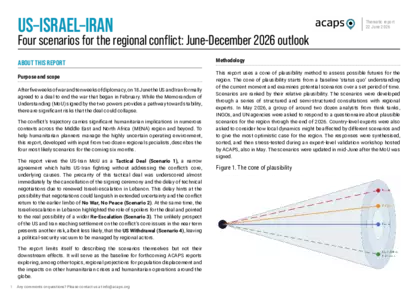
US-Israel-Iran: four scenarios for the regional conflict, June-December 2026 outlook
DOCUMENT / PDF / 577 KB
The conflict’s trajectory carries significant humanitarian implications in numerous contexts across the Middle East and North Africa (MENA) region and beyond. To help humanitarian planners manage the highly uncertain operating environment, this report describes the four most likely scenarios for the coming six months.
20 March 2026
Middle East conflict: ripple effects and scenarios
DOCUMENT / PDF / 3 MB
This report uses descriptive, explanatory, and anticipatory analysis to help decision makers understand the scale of the ripple effects from the war, dividing the impacts into four themes:
- energy and water security
- economy, shipping disruption, and food security
- conflict and social cohesion
- humanitarian needs, gaps, and access.
20 March 2026
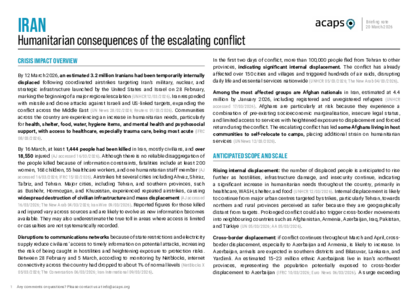
Iran: Humanitarian consequences of the escalating conflict
DOCUMENT / PDF / 526 KB
By 12 March 2026, an estimated 3.2 million Iranians had been temporarily internally displaced following coordinated airstrikes targeting Iran’s military, nuclear, and strategic infrastructure launched by the United States and Israel on 28 February, marking the beginning of a major regional escalation.
10 February 2026
Anticipating Possible US Strikes on Iran
On 6 February, US and Iranian negotiators met in Muscat against the backdrop of potential military confrontation. In recent weeks, the US has been positioning more offensive and defensive military assets into the region than during the June 2025 12-Day War, creating conditions for what Trump dubbed a ‘decisive’ attack against Iran, while Tehran and its regional allies have pledged a ‘painful response’ to any attack, with Iran’s Supreme Leader, Ayatollah Khamenei, warning of a possible confrontation: “this time it will be a regional war.”