

Latest updates on country situation
08 April 2026
Over 60,600 Iranians crossed to Türkiye through the Esendere (Hakkari), Gürbulak (Ağrı), and Kapıköy (Van) border crossings in March 2026, following the start of the Israel–US attacks on Iran on 28 February 2026, although the numbers were less than pre-crisis levels. There is limited information on their whereabouts and needs, but based on previous asylum trends, new arrivals are unlikely accommodated in camps; camp-based housing generally excludes non-Syrians. Instead, they are dispersed across urban areas, initially in border provinces such as Van, and then assigned to satellite cities including Ağrı, Erzurum, and Kayseri for registration and asylum processing. Most arrivals likely stay in overcrowded conditions in rented apartments or share housing with other Iranians. In border areas such as Van, some rely on informal or precarious housing, with limited support from NGOs or diaspora networks. Immediate needs likely include shelter, cash assistance, food, registration, legal documentation, and protection. (UNHCR 02/04/2026, AIDA accessed 08/04/2026, Reuters 02/03/2026)
07 February 2024
One year after the earthquakes that hit Syria and Türkiye in February 2023, humanitarian needs in both countries persist. In Türkiye, as at 18 January 2024, over 670,000 earthquake-displaced people still lived in temporary shelters, mainly in container sites, and needed shelter, NFIs, and WASH assistance. In Syria, the earthquakes aggravated an already existing humanitarian crisis driven by a 12-year conflict accompanied by economic deterioration. In 2024, the number of people estimated to be in need throughout the country increased by 1.4 million compared to the 2023 projection. In northwestern Syria, the area most affected by the earthquake and conflict, over 800,000 people lived in tents and makeshift shelters as at 5 February 2024. Around 2.1 million will require shelter support in 2024, while 1.1 million will require NFI support. WASH, health, and protection needs also remain high in the region. (OCHA 21/12/2023, GSC 05/02/2024, Global Shelter Cluster 25/01/2024)
15 March 2023
On 15 March 2023, the cities of Adiyaman and Sanliurfa in southeast Türkiye were affected by flash floods. The areas involved were already damaged by the earthquakes of 6 and 20 February 2023. The floods destroyed roads and swept cars. Some of the containers housing people displaced by the earthquakes were flooded.
(The Guardian 16/03/2023, BBC 15/03/2023, Aljazeera 15/03/2023)
current crises
in
Turkey
These crises have been identified through the INFORM Severity Index, a tool for measuring and comparing the severity of humanitarian crises globally.
TUR001 - Multiple crisis
Last updated 21/10/2026
Drivers
International Displacement
Earthquake
Crisis level
Country
Severity level
7 High
Access constraints
7.0
TUR002 - Displacement from Syria
Last updated 26/10/2026
Drivers
International Displacement
Crisis level
Country
Severity level
6.8 High
Access constraints
7.0
TUR003 - International Displacement
Last updated 27/10/2026
Drivers
International Displacement
Crisis level
Country
Severity level
5.7 Medium
Access constraints
7.0
Analysis products
on
Turkey
20 March 2026
Middle East conflict: ripple effects and scenarios
DOCUMENT / PDF / 3 MB
This report uses descriptive, explanatory, and anticipatory analysis to help decision makers understand the scale of the ripple effects from the war, dividing the impacts into four themes:
- energy and water security
- economy, shipping disruption, and food security
- conflict and social cohesion
- humanitarian needs, gaps, and access.

13 June 2023
Turkiye: situation analysis 120 days after the earthquakes
DOCUMENT / PDF / 2 MB
This report aims to present a comprehensive review of the main needs of the affected population in Türkiye four months after the February 2023 earthquakes, focusing on shelter, temporary settlement support, WASH, and protection.
Attached resources

02 May 2023
Türkiye: Earthquake and flooding impact in Hatay province
DOCUMENT / PDF / 1,022 KB
Two earthquakes hit southern Türkiye on 6 February 2023, affecting Hatay province. As at 8 April, the province had recorded over 22,000 deaths from the earthquakes, the highest reported across the 11 earthquake-affected provinces in Türkiye. Shelter needs remain an urgent priority.
02 May 2023
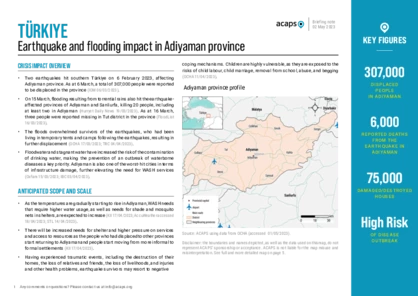
Türkiye: Earthquake and flooding impact in Adiyaman province
DOCUMENT / PDF / 912 KB
Two earthquakes hit southern Türkiye on 6 February 2023, affecting Adiyaman province. As at 6 March, a total of 307,000 people were reported to be displaced in the province. As the temperatures are gradually starting to rise, WASH needs are expected to increase.
24 March 2023
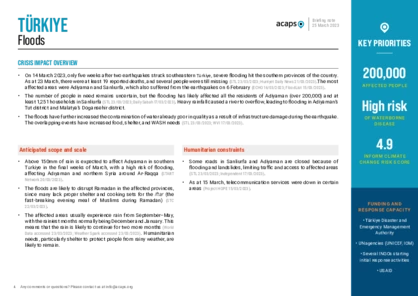
Türkiye: Floods
DOCUMENT / PDF / 180 KB
On 14 March 2023, only five weeks after two earthquakes struck southeastern Türkiye, severe flooding hit the southern provinces of the country. The most affected areas were Adiyaman and Sanlıurfa, which also suffered from the earthquakes on 6 February.
Related content
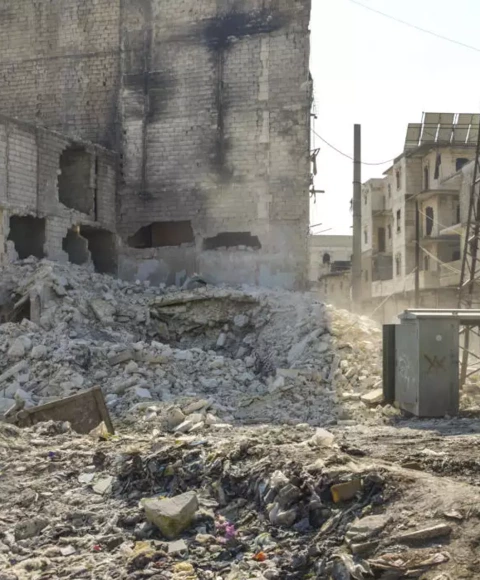
Short-term analysis project
Syria-Türkiye earthquake
The objective of this project is to enable a more evidence-based, localised response and ensure that humanitarian assistance…