

Latest updates on country situation
16 June 2026
Refugees in Malawi – particularly in Dzaleka camp, which hosts refugees from the Democratic Republic of Congo, Rwanda, Burundi, and other countries – are facing worsening conditions because of overcrowding, reduced humanitarian assistance, and restrictive encampment policies. Dzaleka camp, originally designed for 12,000 people, hosted over 52,000 refugees by early 2026, placing sustained pressure on shelter, WASH, healthcare, education, and livelihood access. Reduced assistance is weakening refugees’ coping capacity, with some receiving only USD 6–8 per month and others receiving no assistance and resorting to negative coping strategies, including transactional sex. Water shortages and limited access to necessities are prompting some refugees to leave the camp to seek work, increasing their exposure to exploitation, human trafficking, arrest, and reduced access to assistance. In June 2026, six refugees were sentenced to six months’ imprisonment with hard labour for leaving Dzaleka without exit permits. Malawi’s encampment policy is contributing to rising food, WASH, shelter, and livelihood needs. (Malawi24 15/06/2026, UNHCR accessed 16/06/2026, Radar Africa 04/02/2026)
22 April 2026
In April 2026, fuel prices sharply increased to nearly USD 4/L, around double the global average and the highest in Africa. Petrol prices rose by 45% and diesel by 35% compared to March. The main drivers include supply route disruptions through the Strait of Hormuz, the Government’s decision to remove fuel subsidies, and persistent foreign exchange shortages. This marks the third fuel price increase since President Peter Mutharika returned to power in October 2025. From then until January 2026, petrol and diesel prices increased by 95% and 80%, respectively. These increases have resulted in a worsening cost-of-living crisis, fuel shortages, and livelihood disruptions, particularly for small businesses. Rising global fuel and fertiliser prices are likely to further increase transportation costs and agricultural input expenses, which are expected to contribute to higher food prices and elevated production costs in the upcoming agricultural season beginning in August, further worsening food insecurity. (Nyasa Times 16/04/2026, FEWS NET 08/04/2026, CIJM 05/04/2026)
24 November 2025
Malawi declared a state of disaster on 25 October 2025, later extended to all 28 districts, after prolonged dry spells, high food prices, and economic pressures worsened conditions. Around four million people are projected to face Crisis (IPC Phase 3) and above levels of food insecurity between October 2025 and March 2026. Rising malnutrition, limited food supplies, and high maize prices heighten the need for food, nutrition, and health support. Expected above-normal rainfall may aid crops but increases flooding and disease risks. (OCHA 31/10/2025, WFP 24/11/2025, IFRC 06/11/2025)
27 October 2025
Malawi is projected to face significantly worse food insecurity between October 2025 and March 2026. Four million people are projected to experience Crisis (IPC Phase 3) or worse conditions, including 8,000 in Emergency (IPC Phase 4) levels in Neno district – a significant deterioration from July–September 2025 when 2.9 million people experienced IPC 3 conditions. Acute food insecurity is increasing given poor agricultural yields because of drought and erratic rainfall. High food prices and economic instability, including currency depreciation, inflation, and transportation costs, are further reducing household purchasing power and food access. Given limited resources or lack of money, people are resorting to potentially harmful coping mechanisms, such as harvesting crops early, reducing health spending, and trading labour for food. On 25 October, a state of disaster was declared in 11 districts. Neno (45% of the population affected), Mulanje, and Thyolo (40% each) face the most severe food insecurity. (IPC 17/10/2025, NPL 27/10/2025, EA 28/10/2025)
01 April 2025
Given reduced funding, WFP may halt assistance to refugees and asylum seekers in Dzaleka refugee camp, the main refugee camp in Malawi, after May 2025. Since February, the funding decline has already led to WFP previously reducing food rations from 75% to 50%. In the same month, WFP assisted approximately 57,000 refugees and asylum seekers in the camp, which was designed to accommodate a maximum of 15,000 people. Such overcrowding strains already limited resources and increases the risk of communicable diseases spreading. Access to livelihoods is also highly limited, in large part because of Malawi's encampment policy and restrictions on refugee employment. Only 30% of the camp's population engages in economic activities, leaving many vulnerable. The majority are from the Democratic Republic of Congo, followed by individuals from Burundi and Rwanda, who fled to Malawi with already high needs for food, protection, livelihoods, healthcare, and education. (The Times Group 31/03/2025, Radar Africa 28/03/2025, AfricaBrief 29/03/2025)
18 March 2025
From 10–12 March 2025, Cyclone Jude hit southern Malawi, affecting over 20,000 and displacing over 4,000. By 18 March, those displaced were staying in eight temporary shelters. The cyclone caused flooding in nine southern councils, with Phalombe district being the worst affected. The affected people require shelter, food, NFIs, and healthcare assistance. (OCHA 18/03/2024)
07 January 2025
Mozambique has been experiencing a significant rise in political violence, especially riots and protests, since the disputed general election held in October 2024. Post-election violence has led to hundreds of fatalities in the country and thousands of cross-border displacements, mostly to Malawi. Up until 6 January 2025, around 13,000 people have fled to Malawi, escaping attacks and looting. Many have walked hundreds of kilometres and crossed waterways on foot or by small boats. Most of the displaced are residing in overcrowded makeshift shelters and lack access to adequate WASH facilities. In some displacement sites, around 1,000 people are sharing a single latrine, which significantly increases the risk of disease spread. The displaced urgently need food, potable water, shelter, access to WASH facilities and healthcare, hygiene kits, and household items such as blankets. Humanitarian assistance is being provided, but significant gaps remain. (UNHCR 31/12/2024, RFI 06/01/2025, ACLED accessed 08/01/2025)
current crises
in
Malawi
These crises have been identified through the INFORM Severity Index, a tool for measuring and comparing the severity of humanitarian crises globally.
MWI002 - Climatic shocks
Last updated 30/09/2026
Drivers
Drought/drier conditions
Cyclone
Floods
Political/economic crisis
Crisis level
Country
Severity level
6.6 High
Access constraints
6.0
Analysis products
on
Malawi
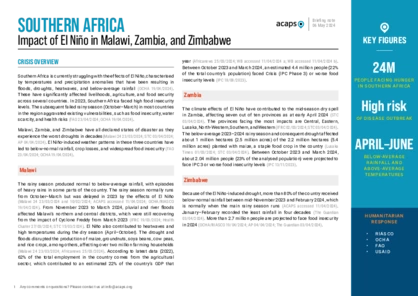
06 May 2024
Southern Africa: Impact of El Niño in Malawi, Zambia, and Zimbabwe
DOCUMENT / PDF / 1 MB
This report provides an overview of the climate effects (temperature and precipitation anomalies) and consequent humanitarian impact of the El Niño phenomenon in Southern Africa
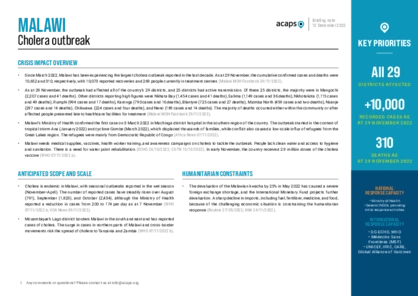
12 December 2022
Malawi: cholera outbreak
DOCUMENT / PDF / 403 KB
Since March 2022, Malawi has been experiencing the largest cholera outbreak reported in the last decade. Malawi needs medical supplies, vaccines, health worker training, and awareness campaigns on cholera to tackle the outbreak. People lack clean water and access to hygiene and sanitation.
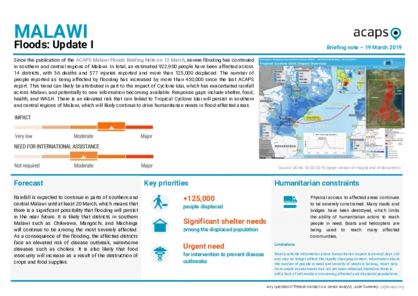
19 March 2019
Malawi: Floods, Update I
DOCUMENT / PDF / 386 KB
Since our last publication, severe flooding has continued in southern and central regions of Malawi. In total, an estimated 922,900 people have been affected across 14 districts, with 56 deaths and 577 injuries reported and more than 125,000 displaced.
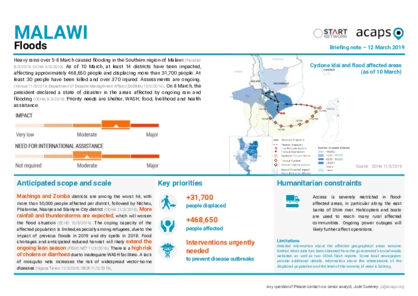
12 March 2019
Malawi: Floods
DOCUMENT / PDF / 570 KB
Heavy rains over 5-8 March caused flooding in the Southern region of Malawi. As of 10 March, at least 14 districts have been impacted, affecting approximately 468,650 people and displacing more than 31,700 people. Assessments are ongoing.