

Latest updates on country situation
28 October 2026
Around 40,000 people have fled clashes in and around Ethiopian Moyale, which Somali and Oromia regions jointly administer, into Kenyan Moyale town, Marsabit county. More than 15,000 are in temporary shelters across eight sites (schools, churches, and a hospital), and over 20,000 are with relatives and friends. Food is the most urgent need, followed by safe drinking water, shelter, sanitation, and healthcare. Rainfall and inadequate sanitation, including insufficient toilets at temporary shelters, increase the risk of waterborne disease outbreaks. Maternal healthcare needs are also emerging, with four births reported at two locations. Clashes between regional forces have spread across seven districts in southern Oromia after a disagreement over raising the Somali flag, part of a long-running boundary dispute. Until 30 September, Kenya was hosting 43,434 Ethiopian refugees and asylum seekers out of 879,452. Marsabit leaders say resources are stretched and business in Moyale has stopped. (AS 27/10/2026, KNCHR 27/10/2026, Nation 27/10/2026)
29 July 2026
In the arid and semi-arid lands, an estimated 3–3.49 million people will need food assistance between June 2026 and January 2027, with needs peaking from September–October. Refugees in Dadaab, Kakuma, and Kalobeyei camps, mostly from Somalia, are among the populations of greatest concern, with Crisis (IPC Phase 3) outcomes persisting given restrictive refugee employment policies and households' limited ability to grow their own food. The country is also anticipating a weak cereal harvest, while a revised El Niño forecast will bring enhanced rains through January 2027 instead of ending in December, with a 63% probability of conditions strengthening to very strong between November 2026 and January 2027. While enhanced rainfall could improve farm output, flooding is expected on a scale comparable to 2023 and 2019, when El Niño-driven floods displaced 136,000 and 145,000 people, respectively. The 2019 floods also destroyed over 10,000 acres of cropland. (FEWS NET 30/06/2026, OCHA 06/07/2026, PD 25/07/2026)
06 January 2026
An estimated 2.1 million people across 32 counties are experiencing heightened food and nutritional insecurity following the failure of the October–December 2025 short rains. Livelihoods in arid and semi-arid land areas are the most affected, with impacts increasingly extending into typically food-secure regions. The Kenya Meteorological Department projects sustained food, nutrition, and health assistance needs over the next six months. Baringo, Garissa, Isiolo, Mandera, Marsabit, Samburu, Turkana, and Wajir are the most affected. In Wajir county, deteriorating rangeland conditions, reduced livestock productivity, and critical water shortages are accelerating food insecurity, malnutrition risks, and resource-based tensions. (Govt.Kenya 04/12/2025, Citizen 15/12/2025, [The Star 06/01/2026] (https://www.the-star.co.ke/news/2026-01-06-met-it-will-be-hot-dry-till-march-but-rain-in-some-places))
18 November 2025
From October 2025 to January 2026, an estimated 2.1 million people across Kenya’s pastoral regions are projected to face high acute food insecurity of Crisis (IPC Phase 3) or worse levels, particularly in Garissa, Mandera, Marsabit, Tana River, Turkana, and Wajir counties. This represents a 2% compared to the same period last year. The primary drivers of the significant expansion of these widespread crisis outcomes included forecasted significantly below-average short rains from October–December and persistently high temperatures. This climactic failure will severely hinder rangeland recovery, leading to atypically low livestock productivity and reduced herd sizes. The resulting collapse in household income, coupled with elevated staple food prices, will limit purchasing power and force the unsustainable exploitation of livelihood assets. The deterioration is expected to be most acute during the short rains season, with resource-based conflicts acting as a major aggravating factor. (IPC 08/09/2025, FEWS NET 31/10/2025, WFP 11/11/2025)
14 October 2025
By September 2025, Kenya was hosting 864,693 refugees and asylum seekers, primarily in Dadaab, Kakuma, and Kalobeyei. The 2025 REACH Multi-Sector Needs Assessment indicates a sharp deterioration in living conditions from funding shortfalls, forcing WFP to reduce rations to 28% of the minimum food basket and suspend cash assistance. Food insecurity remains the most pressing need. Households increasingly rely on in-kind aid, borrowing, and credit. Water access is unreliable, and 72% of households lack handwashing facilities, heightening WASH-related health risks. Child health and nutrition outcomes have worsened; only 44% of children have received vitamin A supplements and 53% deworming treatment. The average household income – KES 6,982 (USD 54) – remains well below the minimum expenditure basket of KES 16,424 (127), pushing 74% of families to adopt potentially harmful coping strategies. Education attendance has declined amid financial barriers and child labour. Only 10% of households received aid in the past three months, reflecting growing vulnerability across camps. (IOM/REACH 06/10/2025, UNHCR accessed 16/10/2025)
15 September 2025
Since June 2025, over 9,300 South Sudanese refugees have returned from Kakuma and Kalobeyei camps in Kenya, with daily arrivals peaking at over 220 in August. The movement is prompted by food ration cuts that have left 85,000 (45% of camp populations) without assistance, triggering protests. Kakuma and Kalobeyei were hosting nearly 191,000 South Sudanese refugees. Two-thirds of the returnees are children, many arriving through Nadapal town into eastern Equatoria before moving to Budi, Ikotos, Kapoeta, and Torit towns. Families face ambush risks, lack of reception facilities, unsafe sanitation, and exposure to gender-based violence and disease at the border. While many returnees rejoin relatives, host households are increasingly overstretched, leading to overcrowding, food insecurity, and limited health and shelter access. Urgent needs include food, safe water, health services, and protection support especially for children and women, alongside assistance for host communities. (UNHCR 11/09/2025, TRT Afrika 29/08/2025, Radio Tamazuj 14/08/2025)
26 August 2025
Since late July 2025, intensified cross-border fighting in Betel Hawa town of Gedo region, Somalia, has spilled into Mandera East subcounty in Kenya, triggering large-scale displacement. By 17 August, over 7,700 people had been displaced within the township ward, while around 3,000 refugees were registered in camps at Barwaaqo, Duse, and Shafshafey schools by 19 August. The displaced population largely comprises women-headed households with young children, heightening protection concerns. Nearly half of the affected households have reported losing their livelihoods in the past month, leaving families without income and dependent on aid. Shelter conditions remain precarious, with people staying in schools, tents, and open spaces. Food shortages, limited safe water, and disrupted health services further heighten needs as the crisis places additional strain on the already limited resources. (IOM 20/08/2025, KNA 30/07/2025, FTL 31/07/2025)
current crises
in
Kenya
These crises have been identified through the INFORM Severity Index, a tool for measuring and comparing the severity of humanitarian crises globally.
KEN001 - Multiple crisis
Last updated 26/10/2026
Drivers
Drought/drier conditions
International Displacement
Crisis level
Country
Severity level
6.8 High
Access constraints
4.0
KEN002 - International displacement
Last updated 21/10/2026
Drivers
International Displacement
Crisis level
Country
Severity level
5.6 Medium
Access constraints
4.0
KEN003 - Drought in ASAL areas
Last updated 21/10/2026
Drivers
Drought/drier conditions
Crisis level
Country
Severity level
6.7 High
Access constraints
3.0
Active risks
Analysis products
on
Kenya
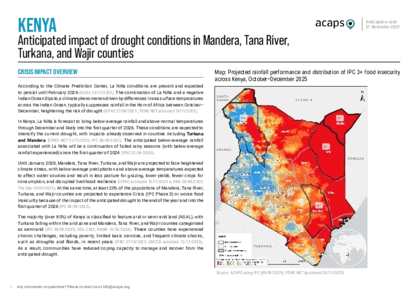
27 November 2025
Kenya: Anticipated impact of drought conditions
DOCUMENT / PDF / 497 KB
This report examines projected drought conditions in a select sample of northern and eastern counties (Mandera, Tana River, Turkana, and Wajir) in ASAL regions that climate forecasts and early warning indicators project will experience some of the most severe impacts.
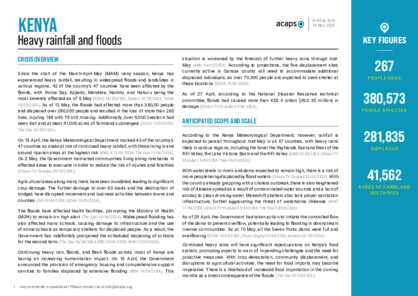
14 May 2024
Kenya: heavy rainfall and floods
DOCUMENT / PDF / 2 MB
Since the start of the March-April-May (MAM) rainy season, Kenya has experienced heavy rainfall, resulting in widespread floods and landslides in various regions. 42 of the country’s 47 counties have been affected by the floods, with Homa Bay, Kajiado, Mandera, Nairobi, and Nakuru being the most severely affected as of 6 May.
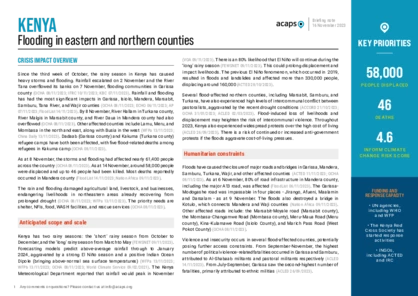
16 November 2023
Kenya: flooding in eastern and northern counties
DOCUMENT / PDF / 867 KB
Since the third week of October, the rainy season in Kenya has caused heavy storms and flooding, significantly impacting Garissa, Isiolo, Mandera, Marsabit, Samburu, Tana River, and Wajir counties. As at 8 November, the storms and flooding had affected nearly 61,400 people across the country.
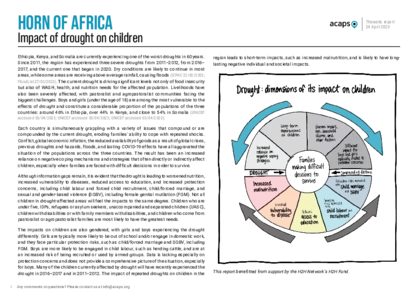
24 April 2023
Horn of Africa: Impact of drought on children
DOCUMENT / PDF / 5 MB
Ethiopia, Kenya, and Somalia are currently experiencing one of the worst droughts in 60 years. The current drought is driving significant levels not only of food insecurity but also of WASH, health, and nutrition needs for the affected population.
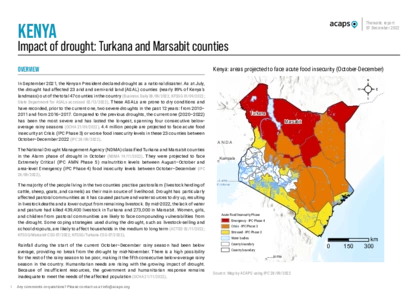
07 December 2022
Kenya: impact of drought in Turkana and Marsabit counties
DOCUMENT / PDF / 2 MB
In September 2021, the Kenyan President declared drought as a national disaster. As at July, the drought had affected 23 arid and semi-arid land counties out of the total 47 counties in the country. 4.4 million people are projected to face acute food insecurity at Crisis (IPC Phase 3) or worse food insecurity levels in these 23 counties between October–December 2022.