

Latest updates on country situation
18 March 2026
Between 10–11 March 2026, torrential rains triggered landslides and flash floods in Gamo zone, southern Ethiopia, rapidly escalating into a humanitarian emergency. Authorities estimate over 3,000 displaced people, who are sheltering in churches, schools, and open spaces. By 15 March, at least 125 people had died, with others still missing. The worst-affected areas include Kuyile, Laka, and Mazo Doisa, alongside kebeles in Bonke, Gacho Baba, Kamba Zuria, and West Abaya woredas. The floods and landslides have affected around 11,000 people in more than 11 villages and destroyed at least 780 homes, along with farmland and key infrastructure. Blocked roads, debris, and difficult terrain highly constrain access, limiting rescue and relief efforts. Priority needs include food, emergency shelter, NFIs, WASH services, healthcare, trauma care, water treatment, and nutrition support. Continued rainfall increases the risk of further landslides, while overcrowding and poor sanitation heighten the risk of waterborne disease outbreaks. (Reuters 16/03/2026, AS 13/03/2026, ECHO 13/03/2026)
23 September 2025
By September 2025, around 1.2 million children, nearly 46% of the school-age population in Tigray, were out of school, according to the regional Bureau of Education, largely due to the lingering social and economic impacts of the war. Nationwide, more than 8.3 million children were out of school by June 2025, driven by conflict, displacement, climate shocks, and insecurity. The prolonged lack of educational access has heightened protection risks, leaving children increasingly vulnerable to early marriage, hazardous labour such as mining, and unsafe, irregular migration. (AS 19/09/2025, UNICEF 02/01/2025, TR 22/02/2025, Education Cluster accessed 25/09/2025)
26 August 2025
Communities in Tselemti (North Western zone) and Kola Temben (Central zone) woredas of Tigray are facing worsening conditions as prolonged drought compounds the impact of the 2020–2022 conflict. Media reports suggest nearly 50,000 people in Tselemti are struggling with hunger and displacement, with more than 9,000 livestock lost. In Kola Temben, at least 22 people and over 27,000 livestock are reported dead based on unverified figures. Alarming malnutrition levels linked to failed harvests further aggravate the situation. Proxy global acute malnutrition rates have reached 62% among children under five and over 70% among pregnant and lactating women, heightened by limited health and nutrition services. Forecasts for the October–December Deyr season point to below-average rainfall across much of the Horn of Africa. If this materialises in northern Ethiopia, drought conditions are likely to persist into early 2026, prolonging already critical humanitarian needs. (AS 19/08/2025, ECHO 14/08/2025, ICPAC 26/08/2025)
10 June 2025
In late May 2025, escalating armed violence by non-state armed groups in the border areas of Oromia and Benishangul-Gumuz regions of Ethiopia displaced over 11,000 people. This violence, driven by political and ethnic tensions, has severely affected communities in Harowata kebele of Sasiga district (Oromia region), displacing approximately 5,500 people. At the same time, the attacks have forced around 5,900 people in Kamashi zone (Benishangul-Gumuz region) to flee. An attack on 20 May in Mizyiga, Kamashi zone (Benishangul-Gumuz region), resulted in at least 16 casualties, abductions, and arson. Some of the displaced are seeking shelter in government buildings. Their priority needs include food assistance, NFIs, and protection services. (ECHO 06/06/2025, Protection Cluster 10/06/2025, The Reporter 24/05/2025)
08 April 2025
Between January–February 2025, an estimated 1,200 people fled to North Western zone from various zones in Tigray region because of insecurity and fear of conflict, illustrating continued population movement. These newly displaced people add to the more than 750,000 people who were internally displaced across Tigray in August 2024. The continued arrival of displaced people aggravates an already dire situation. These individuals live in poor conditions within collective sites, particularly in schools and makeshift shelters, that are often overcrowded, putting pressure on limited resources and further challenging their wellbeing. The situation raises health and protection concerns for them and strains the relationship between the host community and IDPs, as residents experience disruptions to essential services, especially education, with many displaced individuals sheltering in schools. The primary needs identified include shelter, livelihood, food and NFIs, health, and WASH services. (GSC 04/04/2025, UNHCR 28/02/2025, IOM 21/02/2025)
01 April 2025
In the 2024–2025 academic year, more than 7.2 million students across Ethiopia have been unable to attend school owing to conflict and insecurity. Amhara region is the hardest hit, with over 3,600 schools already closed and 4.5 million students out of school. This is an increase of over 500,000 students since October 2023, when approximately 3.9 million primary and secondary students were out of school in the region. Attacks have targeted educational infrastructure, while teachers and school administrators have faced threats, detention, and even killings, further disrupting education and making it unsafe for learning to continue. Fano militia have also previously ordered schools to close and demanded ransom for kidnapped teachers. (AS 31/03/2025, African Perceptions 25/03/2025, NDTV 24/01/2025)
11 February 2025
By 6 February 2025, the resurgence of cholera in Amhara region had produced over 160 cases and killed three. Of these, 125 cases and two deaths occurred in West Gondar zone, three cases and one death in Central Gondar, and 33 cases in Bahir Dar, the region’s capital. Humanitarian access restrictions from armed conflict in the region will likely hinder the response. (ECHO 06/02/2025, AS 07/02/2025)
current crises
in
Ethiopia
These crises have been identified through the INFORM Severity Index, a tool for measuring and comparing the severity of humanitarian crises globally.
ETH006 - Conflict, Climatic and Economic shocks
Last updated 27/08/2026
Drivers
Conflict/ Violence
Floods
Drought/drier conditions
Political/economic crisis
Crisis level
Country
Severity level
8.4 Very High
Access constraints
10.0
ETH001 - Multiple crises
Last updated 27/08/2026
Drivers
International Displacement
Conflict/ Violence
Drought/drier conditions
Floods
Political/economic crisis
Crisis level
Country
Severity level
8.7 Very High
Access constraints
10.0
ETH003 - International Displacement
Last updated 27/08/2026
Drivers
International Displacement
Crisis level
Country
Severity level
6.8 High
Access constraints
9.0
Active risks
Analysis products
on
Ethiopia

10 July 2026
Global impacts of the conflict in the Middle East
DOCUMENT / PDF / 882 KB
This report assesses the current and anticipated global humanitarian impacts of the conflict between US–Israel and Iran. It examines how the severity of the shocks transmitted through energy and fertiliser markets, trade routes, financial flows, humanitarian logistics, and regional political instability intersect with existing humanitarian needs and limited coping capacity.
15 July 2025
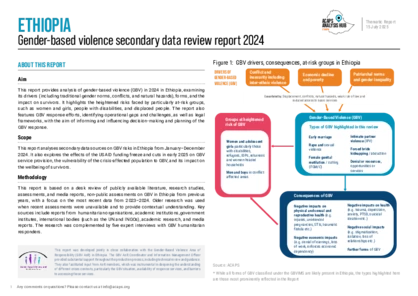
Ethiopia: gender-based violence secondary data review report 2024
DOCUMENT / PDF / 867 KB
This report provides analysis of gender-based violence (GBV) in 2024 in Ethiopia, examining its drivers (including traditional gender norms, conflicts, and natural hazards), forms, and the impact on survivors.
13 March 2025
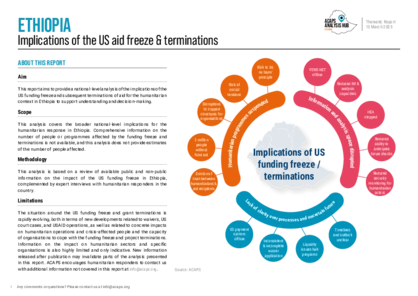
Ethiopia: implications of the US aid freeze & terminations
DOCUMENT / PDF / 1 MB
This report aims to provide a national-level analysis of the implications of the US funding freeze and subsequent terminations of aid for the humanitarian context in Ethiopia to support understanding and decision-making.
Attached resources

05 July 2024
Ethiopia: situation and needs of Sudanese refugees in Amhara region
DOCUMENT / PDF / 529 KB
This report analyses the humanitarian needs of Sudanese refugees hosted at the Kumer and Awlala refugee camps, those who left and are sheltering outside, and the factors aggravating the situation in order to support humanitarian decision-making.
Attached resources
18 January 2024
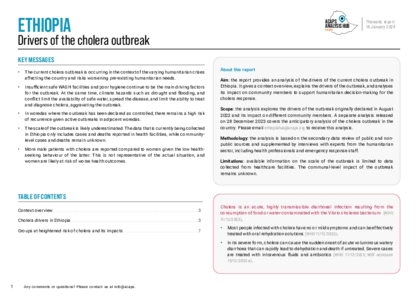
Ethiopia: drivers of the cholera outbreak
DOCUMENT / PDF / 1 MB
The report provides an analysis of the drivers of the current cholera outbreak in Ethiopia. It gives a context overview, explains the drivers of the outbreak, and analyses its impact on community members to support humanitarian decision-making for the cholera response.