

Latest updates on country situation
20 May 2026
On 15 May 2026, the Ministry of Health declared a new Ebola outbreak in Ituri province caused by the Bundibugyo strain, for which there is currently no licensed vaccine or specific treatment available. On 19 May, authorities reported more than 536 suspected cases and 134 deaths. Cases have also spread beyond Ituri into Goma and Botembo in Nord-Kivu province. WHO declared a Public Health Emergency of International Concern after two cases were confirmed in Uganda. During the 2007 and 2012 outbreaks, the estimated fatality rate ranged between 25–40%. This is unfolding in conflict-affected areas marked by displacement, with 922,000 people displaced by April, as well as insecurity, weak health services, and high cross-border mobility linked to trade and mining activities, complicating surveillance, contact tracing, and humanitarian response operations. Urgent needs likely include access to safe drinking water, improved sanitation infrastructure, and access to essential healthcare services and hygiene items. (WHO 17/05/2026, Health Cluster 18/05/2026, MSF 19/05/2026)
01 April 2026
Between 24–26 March 2026, heavy rainfall and subsequent flooding affected 223,000 people across the country, with reported fatalities, displacement, and widespread damage, including an unknown number of houses damaged or destroyed. The most affected areas include Haut-Lomami (Bukama territory) and Maniema (Kindu city) in the east and Nord-Ubangi (Gbadolite city) in the north, where over 81 people were injured and 9,140 displaced in total. The overflowing of mainly the Mikelengem, Kaponjo, and Cano Rivers also contributed to displacement. Urgent needs likely include shelter, ready-to-eat meals, clean water, and healthcare services. Forecasts indicate more heavy rainfall in the coming days, within a broader rainy season that typically lasts until June and resumes from August–December. This situation may also heighten the risk of outbreaks of diseases such as measles, which has been reported in Nord-Ubangi and Maniema, and cholera, which was reported in Maniema and Haut-Lomami in January. (ECHO 27/03/2026, IFRC accessed 31/03/2026, MSF 27/01/2026)
18 March 2026
Cholera transmission continues across the Democratic Republic of Congo, with over 71,200 cases and 2,070 deaths reported in 2025 and the disease still spreading in 2026. Flooding in eastern areas is intensifying the outbreak by damaging already fragile water and sanitation systems, particularly in conflict-affected areas, forcing affected populations to rely on unsafe water sources and increasing exposure to waterborne diseases. The outbreak is increasing morbidity risks and pressure on overstretched health services. Priority needs include safe water access, cholera treatment capacity, and prevention in displacement- and flood-affected areas. (WHO 02/03/2026, REACH 23/02/2026, UNICEF 27/01/2026)
23 February 2026
By 23 February 2026, intense fighting in the Minembwe highlands (Sud-Kivu) had displaced over 200,000 civilians since early February. Most have fled to Fizi territory, facing limited access to basic assistance. Clashes have destroyed homes and led to the closure of health facilities, schools, and markets. (RFI 23/02/2026, CT 20/02/2026)
05 January 2026
Democratic Republic of Congo (DRC) forces and the March 23 Movement have been engaged in intensified armed clashes around Uvira town (Sud-Kivu) since early December 2025, triggering large-scale displacement into Burundi. By 28 December, 101,000 individuals from eastern DRC had arrived through the Buganda, Gatumba, and Rumonge border points. Crossings have continued into January 2026, sustaining pressure on reception and transit capacities. The influx is heightening public health, nutrition, and protection concerns in Burundi. Rising food insecurity and limited WASH access are increasing malnutrition and disease risks, particularly among children. Protection incidents include cases of unaccompanied and separated children and heightened exposure to gender-based violence, exploitation, and abuse. Amid a cholera outbreak, insufficient diagnostic capacity, limited inpatient facilities, and weak referral systems are aggravating morbidity and mortality. Humanitarian priorities include improving mobile health and nutrition services, disease surveillance, WASH infrastructure, and decongestion measures at entry and transit sites. (RFI 04/01/2026, RFI 01/01/2026, (Govt. Burundi/UNHCR 28/12/2025, UNICEF 05/01/2025)
09 December 2025
Renewed violence in Sud-Kivu has displaced over 200,000 people from Kamanyola, Katogota, and Luvungi localities since 2 December 2025. Clashes between the Congolese army, Wazalendo militias, and the March 23 Movement have killed at least 70 people and injured 80. Displaced families are staying in overcrowded shelters, with limited healthcare access amid a nurses’ strike and heightened risks of gender-based violence and disease outbreaks, including cholera and measles. The fighting persists despite a peace agreement between Rwanda and the Democratic Republic of Congo signed on 4 December, spilling over to Burundi, where 3,000 people are facing overcrowded and fragile conditions at the Cishemere transit centre in Cibitoke province – well beyond its capacity. Violence is disrupting education, with nearly 1,300 schools in Sud-Kivu nonfunctional and learning disrupted for over 390,000 children by 4 December. Armed presence near schools, infrastructure attacks, and unexploded ordnance further threaten children’s safety. (OCHA 09/12/2025, OCHA 08/12/2025, Education Cluster 08/12/2025)
04 November 2025
Armed conflict persists in Nord-Kivu province despite renewed peace efforts, with clashes between the March 23 Movement (M23), the Congolese army (FARDC), and allied Wazalendo militias intensifying territorial competition. In September 2025, fighting continued across Masisi, Rutshuru, and Walikale territories, causing further displacement. More than 1,300 protection incidents were reported that month – including killings, abductions, and sexual violence – mirroring the high levels recorded in August and highlighting sustained protection risks for civilians. By October, Nord-Kivu was hosting over 1,152,000 IDPs, a slight decrease from August partly linked to population movements following M23’s advances into Goma and surrounding areas earlier in the year, which initially triggered large-scale displacement but later saw many people returning to their areas of origin. Displaced populations continue to face severe needs amid limited humanitarian response capacity. (Protection Cluster 20/10/2025, Critical Threats 29/10/2025, IOM 21/10/2025)
current crises
in
DRC
These crises have been identified through the INFORM Severity Index, a tool for measuring and comparing the severity of humanitarian crises globally.
COD001 - Complex crisis
Last updated 30/06/2026
Drivers
Conflict/ Violence
Floods
Crisis level
Country
Severity level
9.2 Very High
Access constraints
10.0
Analysis products
on
DRC
22 May 2026
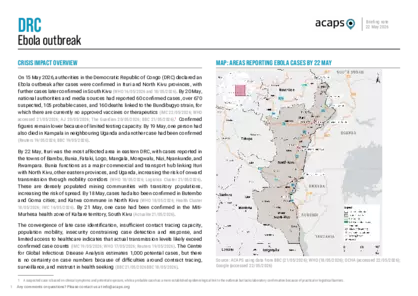
DRC: Ebola outbreak 2026
DOCUMENT / PDF / 371 KB
On 15 May 2026, authorities in the Democratic Republic of Congo (DRC) declared an Ebola outbreak after cases were confirmed in Ituri and North Kivu provinces, with further cases later confirmed in South Kivu.
06 August 2025
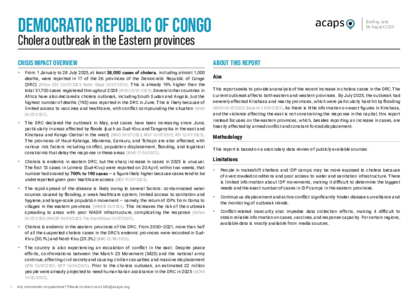
DRC: cholera outbreak in the Eastern provinces
DOCUMENT / PDF / 333 KB
This report seeks to provide an analysis of the recent increase in cholera cases in the DRC. The current outbreak affects both eastern and western provinces. By July 2025, the outbreak had severely affected Kinshasa and nearby provinces, which were particularly hard hit by flooding.
13 March 2025
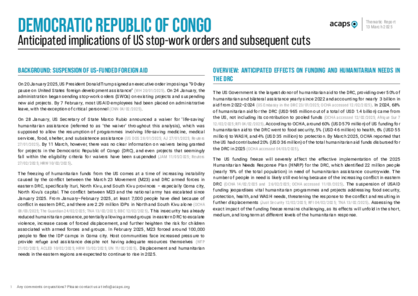
DRC: Anticipated implications of US stop-work orders and subsequent cuts
DOCUMENT / PDF / 1,014 KB
This report analyses the current and potential implications of the US SWOs, subsequent cuts on humanitarian operations, and needs in the DRC, with a focus on the escalating humanitarian needs in eastern DRC provinces as conflict persists.
Attached resources
05 February 2025
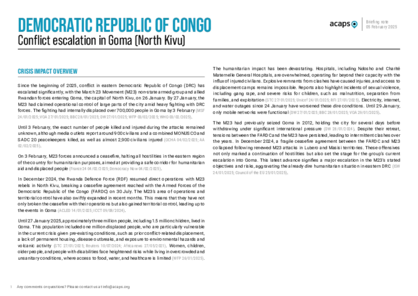
DRC: Conflict escalation in Goma (North Kivu)
DOCUMENT / PDF / 489 KB
Since the beginning of 2025, conflict in eastern Democratic Republic of Congo (DRC) has escalated significantly, with the March 23 Movement (M23) non-state armed group and allied Rwandan forces entering Goma, the capital of North Kivu, on 26 January.

19 December 2024
DRC: conflict across the west
DOCUMENT / PDF / 640 KB
The conflict in Kwamouth territory, Mai-Ndombe province, in the western DRC erupted in June 2022 because of a longstanding dispute between the Teke and Yaka communities over land rights and customary fees. Factors such as increasing population pressure, resource scarcity, and political manipulation have aggravated conflict between the two communities. As of 24 October 2024, 146,000 people have been displaced.