

Latest updates on country situation
13 April 2026
Cross-border displacement from northwestern Nigeria has led to an influx of over 3,000 refugees into Segbana, northern Benin, since mid-February 2026, following violent armed group attacks in Katsina, Niger, and Sokoto states involving killings, kidnappings, and village burnings. Most arrivals, predominantly women and children, fled with limited belongings and are sheltering with host communities already facing constrained resources. The lack of dedicated sites and structured shelters is leading to overcrowding, limited access to safe water, food, shelter, and healthcare, and increasing psychosocial needs, heightening humanitarian concerns. Local response capacity remains limited, while the influx is placing additional pressure on already fragile border areas affected by recurrent insecurity and cross-border movements. Priority needs include shelter, ready-to-eat meals, emergency latrines, vaccination, and protection. Until 28 February, Benin was hosting nearly 29,000 refugees and asylum seekers, most from Burkina Faso. (MSF 07/04/2026, RFI 11/04/2026, Afrik 11/04/2026)
07 July 2025
Around 2,400 Nigerians – over 70% of them children – have fled to Alibori department in northern Benin after civilians were killed by non-state armed groups in Niger’s Dosso region. The influx adds to an already fragile context, with over 26,000 Burkinabe refugees and 13,000 IDPs in the north. (ECHO accessed 03/07/2025)
current crises
in
Benin
BEN002 - Conflict in the Northern region
Last updated 30/09/2026
Drivers
Conflict/ Violence
Crisis level
Country
Severity level
4.7 Medium
Access constraints
2.0
Analysis products
on
Benin
07 February 2025
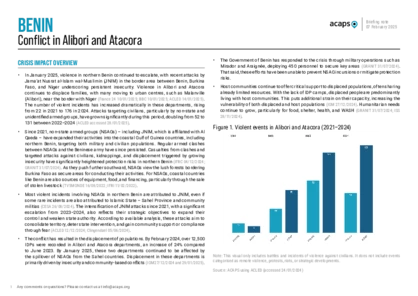
Benin: Conflict in Alibori and Atacora
DOCUMENT / PDF / 677 KB
In January 2025, violence in northern Benin continued to escalate, with recent attacks by Jama’at Nusrat al-Islam wal-Muslimin (JNIM) in the border area between Benin, Burkina Faso, and Niger underscoring persistent insecurity.
30 November 2018
Migration in West and North Africa
DOCUMENT / PDF / 855 KB
These scenarios consider how migration dynamics within and via West and North Africa (including across the Mediterranean Sea) might evolve in the first half of 2019 and the potential humanitarian consequences. The aim is to support strategic planning, create awareness and promote preparedness activities for policymakers and other actors working on migration.